AI Voice Agents in Daycares: A Practical Guide for Modern Childcare Centers
I. Introduction
Running a daycare means managing far more than classrooms, staffing, and daily routines. For many childcare centers, communication has become one of the biggest operational burdens. Parents call with questions about hours, pickup policies, schedules, tuition, availability, tours, and enrollment steps. Prospective families want fast answers. Existing families expect consistency. Staff, meanwhile, are often juggling phones while also supporting children, greeting parents, and handling administrative work.
That pressure has only grown. Families increasingly expect quick, clear, and reliable communication from the businesses and services they trust with their children. If a call goes unanswered or a message sits too long, the result can be frustration for current parents and lost opportunities with new ones.
This is where AI voice agents are starting to gain attention. Rather than replacing staff, they add a support layer that can answer common calls, collect information, route urgent issues, and help centers stay responsive even when teams are busy. Platforms such as Voxana reflect this broader shift by offering AI-powered voice support designed to handle inbound calls, streamline communication, and reduce repetitive front-desk workload.
II. What Are AI Voice Agents?
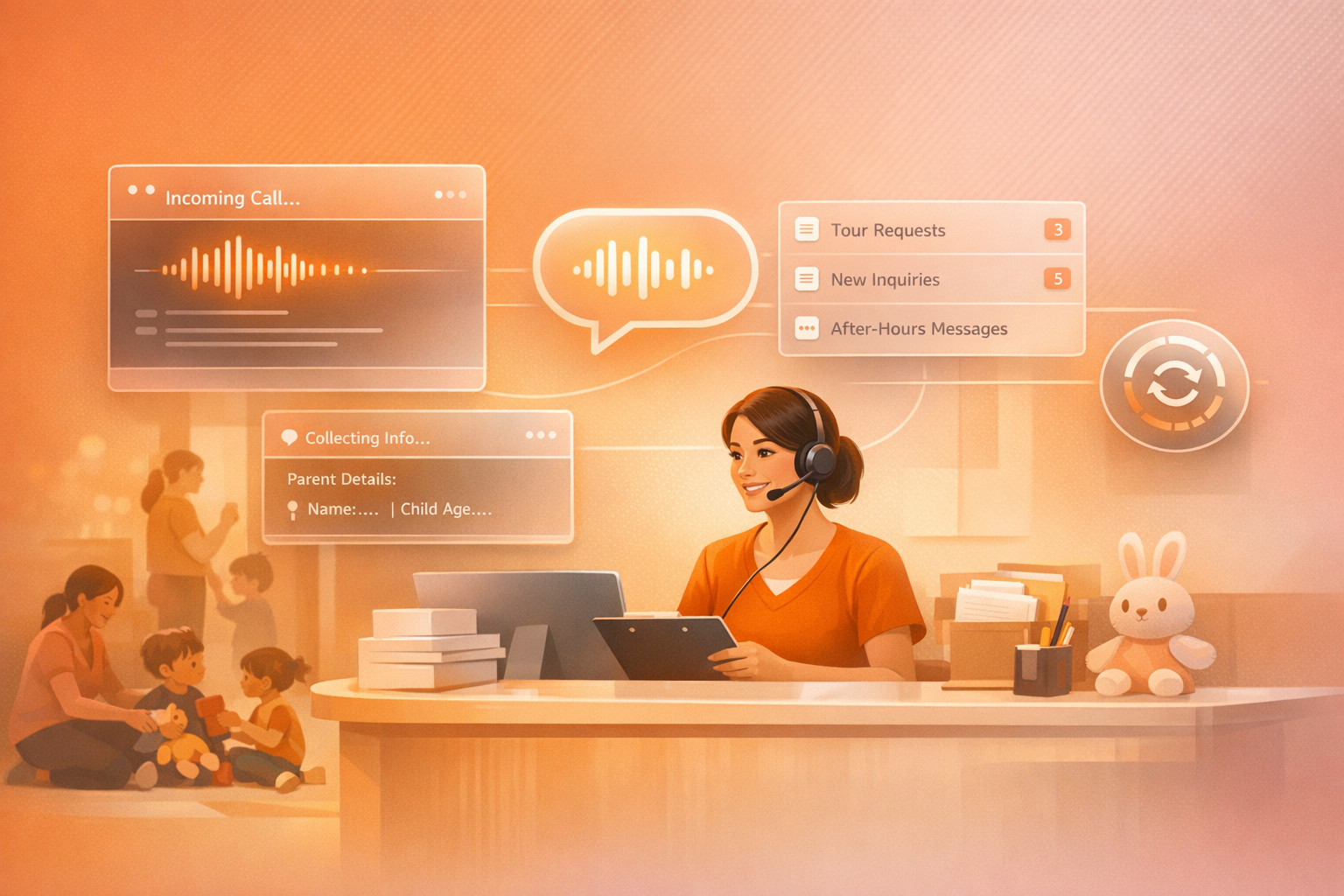
AI voice agents are software-based phone assistants that can speak with callers in a natural way, understand common questions, and respond with useful information. In a daycare setting, they can act as a first line of communication for parents and prospective families.
They are different from older systems like voicemail and traditional phone trees. Voicemail simply records a message after a missed call. A phone tree forces callers through rigid menu options. A live reception-only workflow depends entirely on staff availability. AI voice agents sit somewhere in between automation and human support. They can hold a conversation, respond to frequently asked questions, gather caller details, and direct the call to the right person when needed.
Their core functions typically include:
- Answering incoming calls automatically
- Responding to routine questions
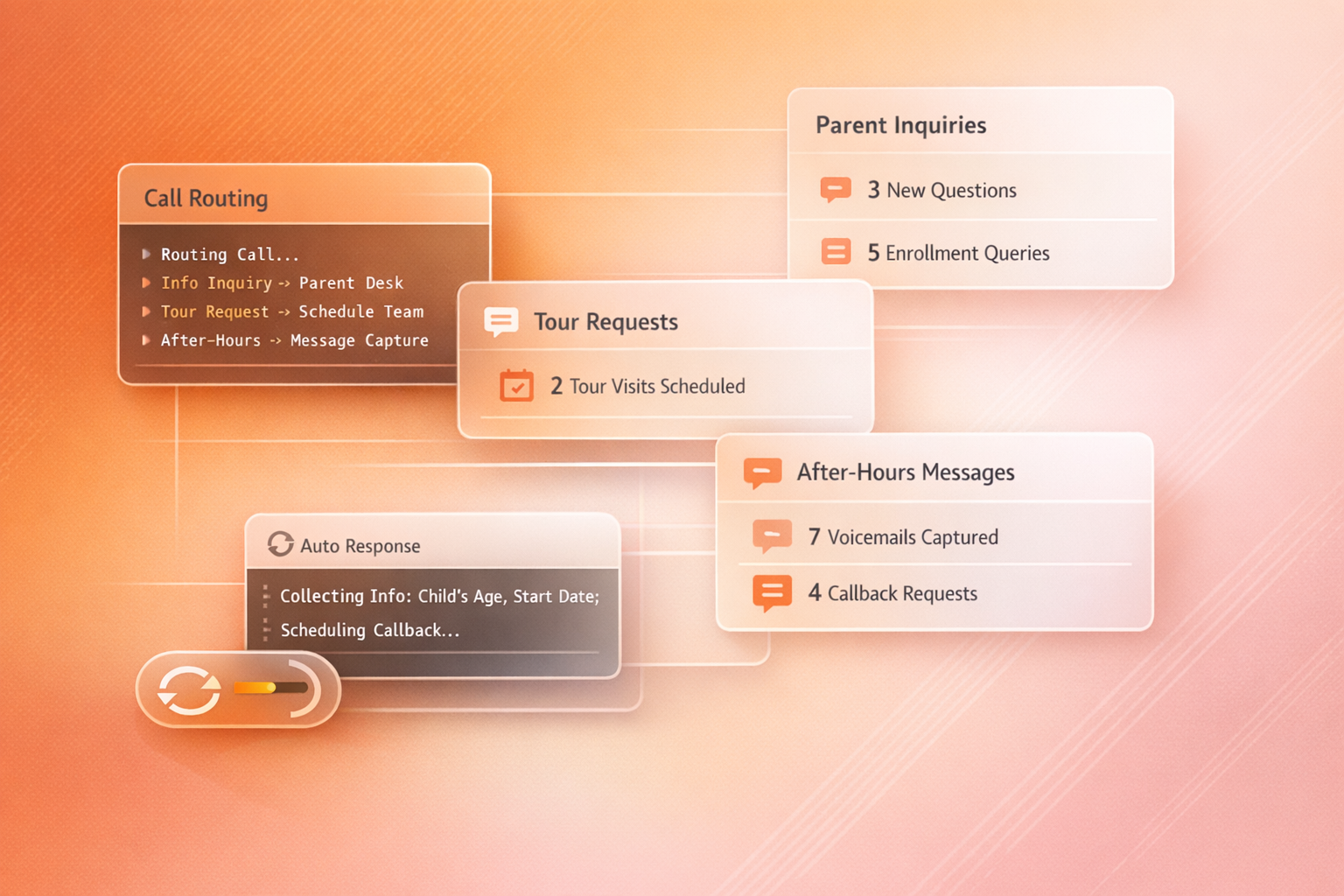
- Routing calls based on the caller’s need
- Capturing important information from parents or prospects
- Triggering follow-ups such as callbacks, notifications, or scheduling steps
For daycares, that means fewer missed calls and a more organized way to manage high-frequency communication.
III. Why Daycares Are Exploring AI Voice Agents
Daycares are under constant communication pressure. Calls tend to spike during key moments of the day, especially during drop-off, pickup, lunch-hour inquiries, and enrollment seasons. At exactly the times staff are busiest, the phone is often ringing the most.
Many of these calls are repetitive. Parents ask about hours, waitlists, tuition ranges, age groups, closure dates, or whether tours are available. These are important questions, but answering the same ones over and over can take staff away from higher-value work and from children themselves.
At the same time, centers want to improve responsiveness without dramatically expanding administrative headcount. Hiring additional front-desk staff may not be practical. Yet failing to answer quickly can affect parent satisfaction and enrollment growth.
AI voice agents appeal to daycare operators because they can help balance both needs: better responsiveness and lower administrative strain. The goal is not to make communication less personal. It is to make basic communication more reliable so staff can focus their human attention where it matters most.
IV. Common Communication Challenges in Daycares
Daycares face several recurring communication problems that make phone management difficult.
Missed calls from prospective parents can be especially costly. A parent looking for childcare may call several centers in a row. If one center does not answer, that lead may move on immediately.
Repetitive questions consume valuable time. Staff often answer the same inquiries about operating hours, tuition basics, program availability, holiday closures, and policies multiple times per day.
Staff interruptions are another major issue. Teachers, directors, and front-desk employees are frequently pulled away from tasks to handle calls, even when the question is simple and predictable.
After-hours inquiries often go unanswered. Many parents call in the evening after work, and prospective families may search for care outside normal office hours. Without a responsive system, those calls become voicemails or disappear entirely.
Inconsistent information can also create confusion. When different staff members answer questions differently, parents may receive mixed messages about schedules, availability, or requirements.
Taken together, these issues create friction for both families and childcare teams.
V. How AI Voice Agents Can Help Daycare Centers
A. Handling Routine Parent Inquiries
One of the most immediate uses for AI voice agents is answering routine questions that follow a predictable pattern. In many daycare centers, a large portion of inbound calls fall into this category.
Examples include:
- Hours of operation
- Tuition and program basics
- Enrollment steps
- Holiday schedules and planned closures
- Pickup and drop-off policies
Instead of forcing staff to answer each of these manually, an AI voice agent can provide consistent responses based on approved center information. That consistency helps reduce confusion while giving parents quick access to what they need.
B. Supporting Lead Capture and Enrollment
AI voice agents can also support the enrollment process by acting as an initial contact point for prospective families. When a parent calls for the first time, the system can answer basic questions and gather important details.
It may collect information such as:
- Parent name and callback number
- Child’s age or age group
- Desired start date
- Program of interest
- Interest in a tour or consultation
From there, the system can route the lead to the appropriate team member, flag urgency, or help schedule a callback. This can be especially useful for centers that receive many inquiries but have limited time to follow up in real time.
C. Improving After-Hours Availability
Parents do not always call during business hours. AI voice agents allow centers to maintain a helpful phone presence 24/7 for common questions.
That can mean:
- Providing immediate answers after hours
- Capturing urgent or time-sensitive messages
- Logging inquiries for next-day staff review
- Reducing the number of lost opportunities from unanswered calls
For centers trying to stay competitive, after-hours availability can be a meaningful advantage.
D. Reducing Front-Desk Workload
A major operational benefit is the reduction in repetitive phone interruptions. Front-desk and administrative staff can spend less time on routine calls and more time on tasks that require human judgment, empathy, and attention.
This can help:
- Reduce multitasking stress for staff
- Improve focus during busy classroom and arrival periods
- Keep administrators available for higher-priority issues
- Support smoother day-to-day operations overall
In a childcare environment, even small efficiency gains matter because staff attention is already stretched.
VI. Real-World Use Cases for AI Voice Agents in Daycares
AI voice agents are most useful when applied to practical, repeatable scenarios. In daycare environments, several use cases stand out.
A new parent calling to ask about openings and age groups is a common example. The AI can explain which programs exist, ask the child’s age, and collect details for a follow-up from the director or enrollment team.
An existing parent checking center hours or closure dates is another straightforward scenario. Instead of placing the caller on hold or sending them to voicemail, the AI can provide the answer immediately.
Families may also call to request tour information. The agent can explain the process, capture interest, and route the request for scheduling.
During peak times, such as seasonal enrollment windows or the start of a new school period, AI can help with call overflow. Even if staff are unavailable, callers still receive a response instead of silence.
For organizations operating multiple sites, AI voice agents can support multilocation daycare groups by centralizing intake, directing callers to the correct location, and standardizing first-response communication across centers.
VII. Benefits for Daycare Operators
For daycare operators, the value of AI voice agents is closely tied to efficiency, responsiveness, and growth.
Key benefits include:
- Faster response times: Calls are answered immediately, even when staff are occupied.
- Better parent and prospect experience: Families get timely, clear information without long waits.
- Fewer missed enrollment opportunities: New leads are more likely to be captured instead of lost.
- More consistent communication: Approved answers reduce variability between staff responses.
- Lower administrative strain on staff: Repetitive phone work decreases.
- Scalable support: As the center grows, communication capacity can expand without increasing phone chaos.
For many operators, these benefits are less about novelty and more about operational stability.
VIII. Benefits for Parents
Parents benefit when communication is easy, predictable, and timely. That is especially true in childcare, where trust and responsiveness matter deeply.
AI voice agents can improve the parent experience by offering:
- Quick answers without long hold times
- Easier access to information outside normal business hours
- A smoother process for enrollment and general inquiries
- More reliable communication overall
For busy parents, convenience matters. A system that helps them get basic answers quickly can reduce stress and make the daycare feel more organized and accessible.
IX. Important Considerations Before Implementation
A. Privacy and Trust
Because daycare communication often involves parent and child-related information, privacy should be a top consideration. Centers need clear boundaries around what an AI voice agent can say, collect, and store.
Best practice includes:
- Handling sensitive information responsibly
- Limiting the AI’s role in conversations involving private or high-risk matters
- Being transparent that the caller is interacting with an AI system
Trust is central in childcare. Any automation used in communication should support that trust, not weaken it.
B. Human Handoff
Not every call should stay with an AI system. Some situations require immediate transfer to a real person.
Examples include:
- Urgent issues involving child safety or attendance
- Sensitive billing or family concerns
- Emotional conversations where reassurance matters
- Complex questions that fall outside approved responses
The strongest implementations treat AI as a first-response layer, not a total replacement for staff. Human handoff should be fast, obvious, and reliable.
C. Customization
Every daycare has its own policies, programs, tone, and operating schedule. An AI voice agent will only be useful if it reflects the center accurately.
Customization should cover:
- Program names and age groups
- Tuition language and enrollment rules
- Pickup, drop-off, and late policies
- Holiday schedules and closure calendars
- The center’s preferred communication tone
Keeping information current is just as important as setting it up correctly in the first place.
X. What to Look for in an AI Voice Agent for Daycares
When evaluating AI voice solutions for a daycare, features matter, but fit matters more. The best system is one that supports the daily realities of childcare communication.
Look for capabilities such as:
- Natural-sounding conversations
- Easy setup and customization
- Call routing and message capture
- CRM or calendar integration
- Reliable after-hours coverage
- Analytics and reporting
- Multilingual support if needed for the families you serve
A daycare does not need the most complex system on the market. It needs one that is dependable, accurate, and easy for staff to manage.
XI. Why Voxana Is Relevant in This Space
Voxana is relevant because it represents the kind of AI voice agent platform that can help organizations handle inbound calls more efficiently. In the daycare context, that matters because so much communication volume comes from routine parent questions, enrollment inquiries, and after-hours outreach.
A platform like Voxana may be a strong fit for childcare centers that want help with:
- Automated handling of inbound calls
- Parent and prospect question management
- Lead capture from new family inquiries
- Reduced staff disruption from repetitive calls
The key positioning is important: tools like this are best seen as support systems for daycare teams, not replacements for the human relationships at the center of childcare. Used well, they can improve responsiveness while leaving staff more available for the conversations that truly need a person.
XII. Best Practices for Rolling Out AI Voice Agents in a Daycare
A successful rollout usually starts small and practical. Rather than automating every possible interaction, daycares should begin with high-volume, predictable scenarios.
Best practices include:
-
Start with repetitive calls
- Focus first on hours, schedules, tours, tuition basics, and enrollment questions.
-
Create clear escalation paths
- Define when the call should transfer, when a message should be taken, and when staff should be alerted urgently.
-
Review call logs regularly
- Listen for recurring gaps, confusing wording, or questions the AI should answer better.
-
Inform staff and parents
- Make sure employees understand the workflow and parents know what to expect.
-
Measure results
- Track missed calls, callback volume, tour bookings, and time saved for staff.
This kind of phased rollout allows centers to improve communication without creating unnecessary risk or confusion.
XIII. Potential Objections and How to Address Them
Some hesitation is natural, especially in a field built on trust and personal care.
“Parents want to talk to a real person.”
That is often true for sensitive or complex issues. But many calls are simple requests for information. AI can handle those first, while still making it easy to reach a human when needed.
“AI may sound impersonal.”
Poorly designed automation does. A well-configured voice agent with clear language, a calm tone, and good escalation rules can feel helpful rather than robotic.
“Childcare communication is too sensitive for automation.”
Some childcare communication is too sensitive for full automation. That is exactly why the right approach is selective use. AI should manage routine, low-risk interactions and pass important matters to staff.
The most effective framing is this: AI voice agents are not there to replace relationships. They are there to reduce friction in the first response.
XIV. The Future of Communication in Childcare
Childcare operations are becoming more digitally supported, especially on the administrative side. As centers look for ways to reduce missed calls, improve responsiveness, and operate more efficiently, automation will likely play a larger role.
The future is not about replacing human care with machines. It is about blending AI efficiency with human-centered service. Daycares that strike that balance can offer families quicker access to information while preserving the warmth and trust that parents expect.
In a competitive childcare environment, better communication can become a real differentiator. Centers that modernize their communication systems may be better positioned to convert inquiries, support existing families, and reduce staff overload at the same time.
XV. Conclusion
Daycares face real communication challenges: missed calls, repetitive questions, staff interruptions, after-hours inquiries, and inconsistent messaging. These issues affect both daily operations and the family experience.
AI voice agents offer a practical way to improve that situation. They can answer routine questions, capture leads, support enrollment workflows, reduce front-desk burden, and help centers stay responsive even when staff are busy.
The best approach is not automation for its own sake. It is thoughtful automation that supports people. For childcare centers, the strongest communication systems will be the ones that combine speed, consistency, and availability with empathy, trust, and a clear path to human support when it matters most.